
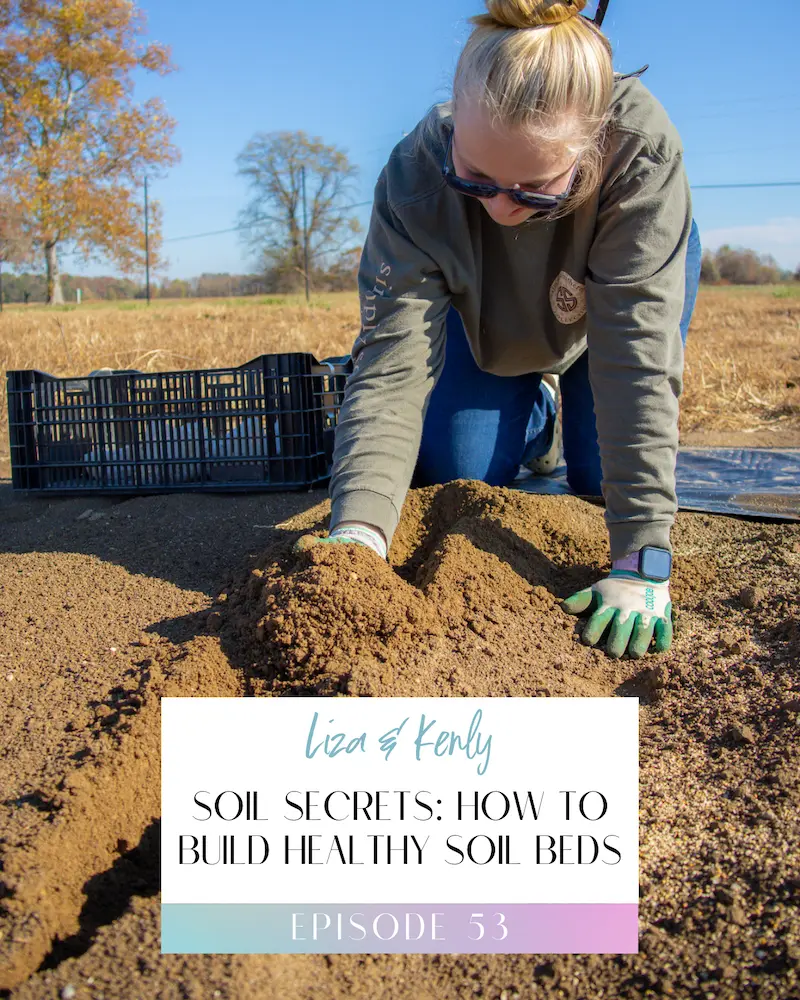
Soil is not dirt.
Dirt is what you sweep up off the kitchen floor. Soil is what you plant into. And if you want lush, healthy flowers, everything starts with what's underneath them.
Here's the thing nobody tells you when you're starting out: your soil can change completely within a hundred feet. On our farm in Maryland, we're close to the Bay and one section is heavy clay so dense you could genuinely throw a pot with it. Walk further out back and it's sandy, almost like being at the beach. Same farm. Same year. Two entirely different growing problems.
So let's work out what you've got.
What is the best soil for flowers?
Loamy soil. It's the ideal, and it's what all the amending in the world is trying to get you to.
Loam is a balanced mix of sand, silt and clay. Water moves in and drains out properly, nutrients are available rather than locked up, and almost everything will grow in it. Dahlias, snapdragons and lisianthus are all happiest here.
Most of us don't start with loam. That's fine. The rest of this is about what to do instead.
The four soil types, and what grows in each
| Soil type | What it does | Best flowers for it | How to improve it |
|---|---|---|---|
| Sandy | Drains very fast, holds almost no nutrients, has no structure to hold onto | Ornamental grasses, lavender, cosmos, zinnias, California poppies | Add organic matter and nutrients, and expect to keep adding, because everything leaches straight through |
| Clay | Dense and nutrient rich, holds water and nutrients so tightly that plants often can't reach them | Rudbeckia (black-eyed Susan), asters, echinacea, daylilies | Add sand, perlite and organic matter to break it apart and improve drainage. This is ongoing, not a one-time fix |
| Silty | Retains moisture and nutrients well, smooth texture, compacts easily which then causes drainage problems | Peonies, roses, delphiniums | Add compost, and stay off your beds |
| Loamy | The balanced ideal. Good drainage, available nutrients, no real drawbacks | Dahlias, snapdragons, lisianthus, and honestly most things | Maintain rather than fix. Keep organic matter up, mulch, and encourage the worms |
A couple of things I found genuinely surprising when I put this list together.
The clay flowers are nearly all perennials, and they share a build: a strong central stem that branches out from there. Daylilies were the one that caught me off guard, until I remembered they grow from a fleshy root rather than a fine fibrous one. That's what lets them push through dense ground.
The silty flowers are the fussy ones. Peonies, roses and delphiniums are three of the most temperamental things we grow, and they want the soil type that compacts most easily. We've always put ours in rich loamy ground.
Sandy soil explains something I'd never questioned. Look at what grows on a beach and it's almost entirely grasses, holding on with tough root systems because there's no structure to hold onto. It's also, I suspect, why so many lavender farms end up near the coast.
How do you tell what soil you have?
Three routes, in the order I'd use them:
- Get it tested. If you have access to a local extension office, the people there genuinely love talking about this. Many will test for you.
- Ask a real garden center. Not a big box store. An actual garden center will have somebody who knows what to do with your answer.
- Ask local growers. Garden clubs and local Facebook groups are full of people growing in exactly your conditions.
Testing is the step people skip, and it's the one that saves the most money. Amending blind is expensive.
What we actually did to our ground
We put down somewhere around two and a half tons of amendment last season. Mushroom soil and sand, spread with a tractor scoop and a manure spreader.
That combination matters, because there's a practical limit to this advice that nobody mentions. Perlite is a genuinely good clay amendment in a raised bed or a container, where it's contained. Try to spread perlite across an open field and it'll blow away before it hits the ground. It doesn't weigh enough for the machinery to even register it.
So scale changes the answer. In a bed, add perlite. In a field, you're looking at sand and organic matter and a spreader.
Stop walking on your beds
I want to give this its own heading because it's the cheapest improvement available and almost nobody does it.
Compacted soil is bad soil. I can walk our rows and point at where somebody stepped, because those three plants look different from the ones either side. You can see the footprint in the growth.
It's the first thing we teach new team members, and it's genuinely not obvious if you've only ever visited a u-pick where everyone tramples everything. Stay in the paths.
If soil is the part that's stumping you
Everything above is the overview. What it doesn't cover is the season-long version: reading a test result and knowing what to actually do about it, choosing amendments for your specific ground, and building a soil that gets better every year instead of starting over each spring.
That's what Soil Made Simple is for. It's the course I built out of exactly these questions, because they're the ones I get asked most.
Soil vs growing media: why we don't use field soil in the greenhouse
This is where people get confused, and it's a fair thing to be confused about.
| Soil | Growing media | |
|---|---|---|
| What it is | A natural mix of minerals, organic matter, water, air and nutrients | A soilless blend made for growing, with no actual soil in it |
| What lives in it | Microbes, earthworms, the whole living system that keeps plants healthy | Nothing, by design. Sterile |
| Where it's used | In the ground | Containers, hydroponics, seed starting trays |
| Can you adjust it? | Yes, by amending over time | Yes, it's built to specification. If you buy the right one you shouldn't need to |
People ask why we don't just scoop soil out of the field for our trays, since it already has everything in it.
Two reasons. First, you'd end up with holes all over the field. Second, and much more seriously, field soil carries disease. I want our seedlings to have the best possible start with nothing to fight. One bad batch can cost a whole crop.
We're also running at a scale that changes the maths. Soil blocking is a lovely method and I'm not afraid of it, but we're growing in 128-cell trays, several hundred of them in the greenhouse at once, on constant rotation. Some need a dome, some don't. Some need bottom watering, some need overhead. That's before you factor in getting the moisture consistency right for blocks to hold together. It doesn't work for us.
What we look for instead is a sterile mix that still has structure, so it holds together at planting, with mycorrhizae for good root development and just enough nutrition to give seedlings a boost before we start our own fertiliser schedule.
We deliberately avoid plain seed-starting mix. It's too fine, has nothing in it, and dries out alarmingly fast.
The soilless media, and what each one is for
Potting mix. The one everybody knows. Lightweight, good for containers, hanging baskets and seed starting. Drains well but dries out faster than garden soil.
Peat moss and coco coir. Both retain moisture and stay light, both lack nutrients so you'll be fertilising. Coco is the more sustainable choice, rewets more easily, and doesn't carry peat's environmental cost. Worth knowing that sphagnum moss and peat moss aren't the same argument. Sphagnum is harvested sustainably. Peat is the one with the problem.
Perlite. The white squishy bits in potting soil that are so satisfying to crush. Extremely porous, excellent for drainage.
Vermiculite. The silvery, slightly slippery, layered stuff. A bit like compressed tinfoil, and it makes your fingers shine. We've used it for slow-germinating seeds like eucalyptus and lisianthus because it discourages algae and stays light enough for seedlings to push through. Over time we found the difference wasn't big enough for us to keep using it, partly because we now buy in most of the very slow germinators.
Compost-based mixes. Nutrient rich and genuinely good for soil health, but heavy for containers, and I'd urge real caution for seed starting.
A cautionary tale about compost mixes
We trialled a beautiful compost-based soil developed by someone we rate. It did not work for us.
It was too heavy to bottom water properly. After three days sitting in the trays it smelled genuinely terrible and had turned a burgundy-brown colour. That was our worst year for disease. We had damping off and problems I hadn't seen before or since.
My read is that it was simply too nutrient rich, too early. Some of our seeds are barely bigger than dust and they can't take that kind of jolt. If you're growing peppers and tomatoes, big seeds, go for it. For fine flower seed, it was too much.
The other risk with compost-heavy mixes is that they aren't always sterile. Somebody once gave us a mix to trial and we put it in the hoop house in the perennial section, and it came up full of sweet grass. We threw the entire thing out rather than risk introducing that into the field.
Whatever you're planting into, make sure it's clean.
Four ways to improve your soil this season
1. Always be adding organic matter. Compost, aged manure, leaf mould. Not mouldy leaves, leaves that have properly broken down.
2. Consider a cover crop. Clover or buckwheat will put nutrients back. Till it in or chop and drop. I'll be honest that this one is hard for us, because our turnover is fast and I like leaving plants standing through winter so the birds have food. We only started clearing that block last week to get ready for cool season crops.
3. Test, don't guess. Covered above, and worth repeating because it's the step that gets skipped.
4. Water properly. Don't stand there in the morning spraying the tops of everything. Get the water down to the soil so the plant can actually reach it. Early morning is the best time, before the sun is scorching, which gives the plant time to take it up before the heat arrives. Avoid midday, you'll scorch things. Avoid night, you'll invite fungus and mould.
Where to go from here
If you're unsure what your soil is, start with a test. If you know what it is and you're not sure what to do about it, start with organic matter, because it improves every soil type on this list. Sandy ground needs it to hold anything at all. Clay needs it to loosen up. Silt needs it for structure. Loam needs it to stay loam.
And if you're intimidated by any of this, don't be. A lot of people are, and it stops them starting. Take your time, don't stress about it, and get your hands dirty.
(In the soil. Not the dirt.)
Frequently Asked Questions
What is the best soil for flowers?
Loamy soil, which is a balanced mix of sand, silt and clay. It drains properly, keeps nutrients available to the plant, and suits almost everything including dahlias, snapdragons and lisianthus. Most gardens don't start out as loam, and improving what you have is the realistic path.
What is the difference between soil and dirt?
Soil is a living system of minerals, organic matter, water, air and nutrients, with microbes and earthworms in it. Dirt is what you sweep off the floor. The distinction matters because the living part is what feeds your plants.
What flowers grow well in clay soil?
Rudbeckia (black-eyed Susan), asters, echinacea and daylilies. They tend to be perennials with strong central stems or fleshy roots, which is what lets them cope with dense ground.
What flowers grow well in sandy soil?
Ornamental grasses, lavender, cosmos, zinnias and California poppies. Sandy soil drains fast and holds few nutrients, so these are plants that don't need much held in reserve.
What is soilless growing media?
A blend made for growing that contains no actual soil, used for containers, hydroponics and seed starting. It's sterile, so there's no disease risk, and it can be mixed to specification. It also has none of the microbial life that field soil has.
Can you use garden soil for seed starting?
We don't, and I'd advise against it. Field soil carries disease that seedlings then have to fight, and one bad batch can cost a whole crop. A sterile media with some structure and a little nutrition is a much safer start.
How do I know what type of soil I have?
Get it tested. Your local extension office is the best starting point, and a proper garden center is the second. Local garden clubs and grower groups are also full of people growing in the same conditions as you.
When is the best time to water flowers?
Early morning, before the sun gets strong, so the plant has time to take the water up before the heat. Avoid midday, which scorches, and avoid night, which encourages fungus and mould.