
Every spring people walk into a seed store, pick up packets of something beautiful, and get their hearts broken by August.
I want to talk about why. Not in the abstract, but with the specific things that have gone wrong here, on this farm, in front of me.
First, "hard to grow" is not one thing
This is the part that gets flattened whenever someone writes a list. A flower can be difficult in at least six different ways, and they need completely different solutions:
| The Problem | What it looks like |
| Hard to germinate | Twelve weeks in a heated greenhouse before anything shows |
| Hard to keep alive | Germinates beautifully, then rots at the base once it hits your soil |
| Hard to time | Grows perfectly, blooms at completely the wrong moment |
| Hard to cut | Easy to grow, and knowing the right day to harvest takes years |
| Hard to handle | Grows and cuts well, then falls apart before it reaches anyone |
| Labor intensive | Nothing about it is difficult except the sheer amount of work |
When you see a flower priced higher than you expected, it is usually one of these. Sometimes several.
...And scale changes everything
Important caveat before any of this is useful to you.
If you have five, six, ten plants in a home garden, most of what follows will not apply. Even at twenty plants you are probably fine. Disease does not spread the same way. One loss is not a crop failure.
We are talking about hundreds of plants. This year we had five rows of dahlias at 400 feet each. At that scale things behave differently, and a problem that is charming in a border becomes a season. If you are weighing up whether to grow flowers at that scale, we have written separately about how to start a flower farm.
Bells of Ireland: the one that beat us
If I had to pick a winner, it is this one, and it is not close.
Bells of Ireland manage to be difficult in every category at once. Hard to germinate, hard to regulate, and prone to disease on top of it.
The germination rate is so low we plant two seeds per cell just to get a workable number of plants, which means using more space to end up with fewer. They want it chilly and they want it wet, but not too cold, and the line between those is narrower than it sounds. They are also covered in spikes, so they are not exactly a pleasure to handle. The bees love them, which is something.
Our best year was in hoop house one, and we think that is because it gets afternoon shade. Everywhere else, they grow to about a foot and then summer arrives and they simply stop.
And then there was the year I had almost fifty feet of them, beautiful, right on the edge of flowering. It was very hot. I had the overhead watering on for a section of young plants nearby, early in the morning, and the overspray reached the Bells of Ireland.
It baked the entire bed.
That is one of those moments where you stand there deciding whether to laugh or cry.
I still feel accomplished every single time we get them to grow, which probably tells you everything.
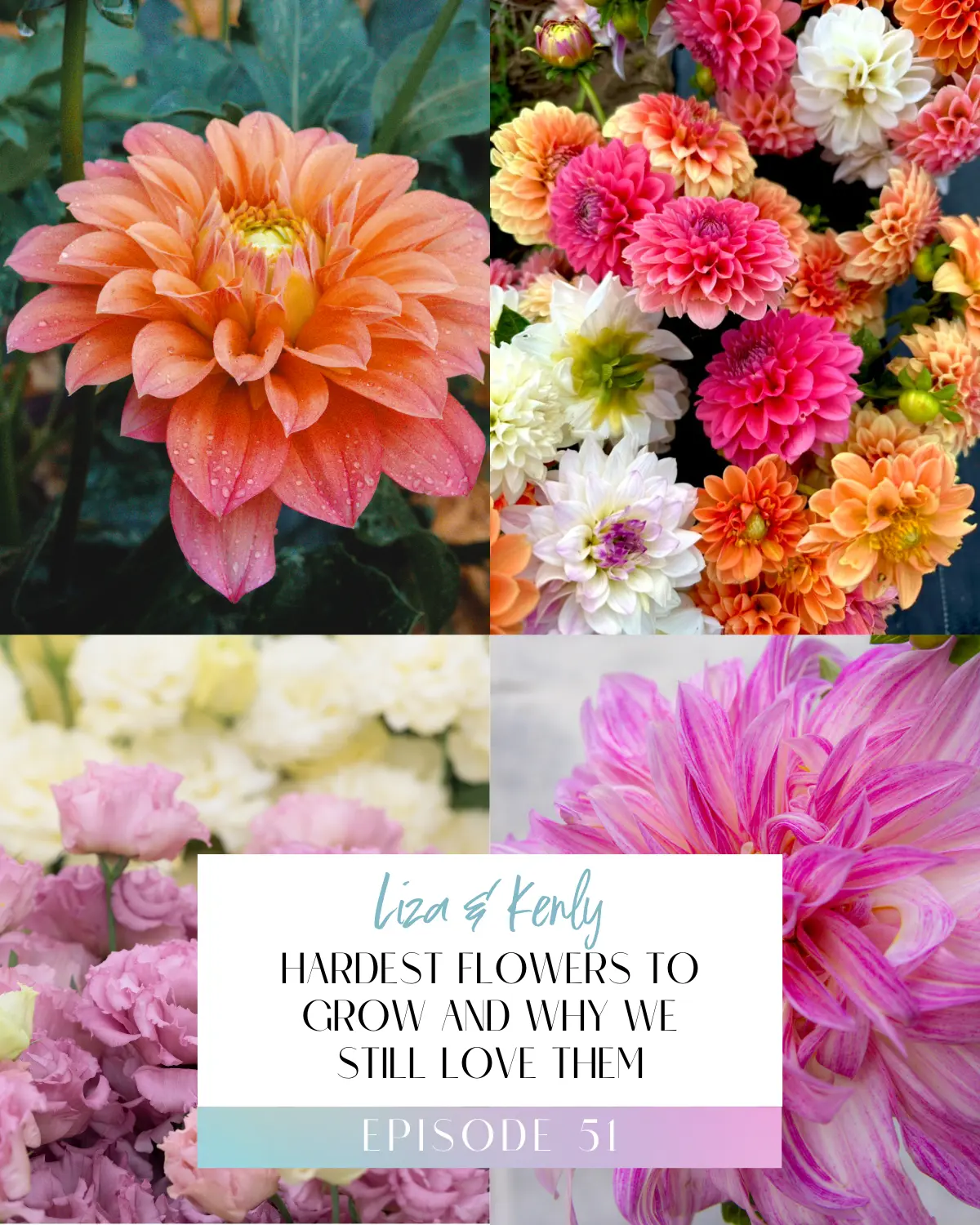
Dahlias: not difficult, just relentless
Everyone glorifies growing dahlias. Nobody shows the labour.
They are not actually hard to grow. They are hard to keep up with, and that is a different thing.
You cannot grow them from seed and get what you planted. Let a pink dahlia go to seed and those seeds will not give you a pink flower in the same shade or size, because the bees cross-pollinate everything. So you buy tubers.
Then the year looks like this. Wait for the right moment to plant. Grow. Cut back. Grow. Cut back. Frost arrives and everything dies down. Cut it all back. Dig every tuber up. Wash them so you can actually see what you are dividing. Divide them. Store them.
We hand-dug about 450 of them this year. By the last fifty feet we looked at each other, decided that section was a mix anyway, and left them in the ground as an experiment to see whether they turn to mush.
Your hands freeze the entire time.
That is before the pests. Something wants to eat the tuber, and something else wants the flower. Every bud that gets big enough gets an organza bag over it to keep insects off, which mostly works, except when you trap one inside.
One more thing worth knowing if you are choosing varieties. Everyone wants the dinner plates. They are spectacular and they are wrong for cut work. Too big, too heavy, they pull on the stem and fall over, and then it rains and they fall over properly. We grow the step down, around eight to ten inches, the Café au Lait sort of size. Sturdy stems, they hold up, they do everything you need.
Lisianthus: we gave up, and it was the right call
We tried to germinate lisianthus once. It took twelve weeks!
They germinated perfectly well in the end. But twelve weeks of greenhouse space, at the quantity we need, starting in December, with the heat that requires. We ran the sums and it simply does not work.
Now we buy them as plugs. A hundred percent success, planted, done. Absolutely not worth the time to do it ourselves.
And while we are here. I saw a video recently claiming you can sprinkle lisianthus seed down the middle of a raised bed and end up with a full blooming bed of them. That is nonsense. Lisianthus seed needs to sit on top of the soil for oxygen and light, and it needs conditions nothing outdoors is going to give it here. Whatever that person filmed, it did not happen the way they said it did.
Eucalyptus: bottom heat and patience
Not a flower, but we use it constantly, so it counts.
Eucalyptus is genuinely miserable to germinate. It wants bottom heat, it wants very particular conditions, and the list of demands is long enough that it is rarely worth it.
The ones that are trickier than they look:
Snapdragons. They germinate fine. The problem is that the seed is so tiny it is difficult to handle at all. One year somebody sprinkled roughly three hundred into a single tray like hundreds and thousands on a biscuit, and they grew. It was our best snapdragon year. The weather helped.
Feverfew. Low germination rate, and another one that needs to sit on top of the soil for light and oxygen.
Eryngium and echinops. Everyone wants blue, and true blue is rare, so these get asked for constantly. Both are difficult.
Stock. There is a trick to it that nobody mentions. When it first germinates you have to identify and pull out certain seedlings by the shape of their cotyledons. Even after that we struggle to grow it on.
Statice. Entirely season dependent. A dry year gives you brilliant colour. A wet one gives you rust.
Acroclinium. Germinates at around 80%, which is fine, and then rots off at the base once it goes in the field, because our soil is heavy. Autumn planting, spring planting, it does not matter.
Larkspur. Not difficult to grow. Difficult to keep, because the rabbits eat it. For a home garden the thing to know is that it needs to be outside through the winter cold with no cover, and if you plant it in April it will not bloom. It gets hot too quickly and larkspur simply gives up. Plant it in the fall instead, and you will have much better luck.
Gerbera daisies. We learned this one the hard way. They want to be pot-bound with a tight root system. In pots they are lovely. Planted in the field they came up two inches tall, and the best of them reached a foot with a flower the size of a spray mum.
Asters. Not hard to grow, brutally hard to time! Plant them wrong and you get something you would pick for a Barbie. They need a long sit before blooming in the fall, and our hot summers push everything forward, or a couple of cool nights convince them it is time and then it is 110 degrees the next day. We plant many rotations to hedge against it, because when they work they are one of our best fall crops.
And sometimes it is the birds
One year we tried to germinate Joe Pye weed. The goldfinches went through the trays and took every seed.
Not the trays either side. Just that one!
I still do not understand how they knew, and I have never called anyone a bird brain since. We ended up putting Agribon over the whole thing, which makes everything else harder.
So what actually wins?
Bells of Ireland. Hardest to germinate, hardest to regulate, most disease prone, and spiky into the bargain.
Dahlias would win a different competition, the one for sheer labour. But they grow. If you want to do the work, do it. Just do not go into it believing it will be easy.
Neither of us expected Bells of Ireland to be the answer when we started talking about this, which is probably the most honest thing in this whole post.
If you want a proper breakdown rather than a list of horror stories, we have put together a guide covering the top flowers to grow through the season, sorted into easy, medium, advanced, and honestly-just-buy-them.
That last category exists because of everything above.
Frequently Asked Questions
What is the hardest flower to grow?
Bells of Ireland, in our experience. Low germination, very particular about temperature and moisture, and prone to disease. They also have spikes. We plant two seeds per cell just to get a usable number of plants.
Are dahlias hard to grow?
Not hard, but relentless. Buy tubers rather than seed, since seed will not come true. Then it is planting, repeated cutting back, digging up after frost, washing, dividing and storing, every year. The growing is straightforward; the labour is not.
Why is lisianthus so expensive?
Germination takes around twelve weeks, needs heat, and needs the seed sitting on top of the soil for light and oxygen. Most growers, including us, buy plugs rather than start it themselves. That cost carries through.
What flowers are hardest to germinate?
Lisianthus at around twelve weeks, eucalyptus which needs bottom heat, Bells of Ireland with a very low rate, and feverfew. Snapdragons germinate well but the seed is so fine it is difficult to sow.
Can beginners grow difficult flowers?
Often yes, at small scale. Most of what makes a flower hard is scale: disease spreads differently across hundreds of plants, and one loss becomes a crop failure. Ten plants in a garden is a very different proposition.