
I keep seeing those little notes all over Instagram lately. The ones that say if you have laundry to do and dinner to cook, the best way to keep the house clean is to go outside and garden.
I feel that in my soul.
Here is the actual idea underneath the joke. Roughly 80% of your results come from 20% of your effort.
Sit with that for a minute.
Now, if I spend 80% of my time in the garden, does that mean my housework magically gets done? No. Sadly, no. It is not an exact mathematical rule. It is a mindset for identifying what truly moves the needle.
And honestly, it changed how I look at this business.
We Are All Stuck in the Busy Trap
Being busy feels productive. Being productive creates results. But those two things are not the same, and I have to remind myself of that constantly.
Here is what the busy trap actually looks like on a farm:
Deadheading flowers that do not need it. You want the garden to look a certain way, but those flowers are going out of season regardless. Meanwhile, the thing you should be doing sits untouched. It just looks really good that you got the deadheading done.
Spending three hours on one Instagram post. I have absolutely been there. I am going to make this post and it is going to be amazing. And then it gets ten likes. I have gotten better about this, but it is still frustrating.
Weeding a section that is not impacting production. This is the exact time of year for it. We have had another thunderstorm day, a full day of rain, and I know crabgrass is about to explode. So I have to make decisions about where it is most productive for us to be working.
I am not going to spend my hours in a section of field that is not going to be productive. But I also do not want weeds over my head. Every single year, some section gets away from us because we are busy working. There is one peony bed I do not even want to talk about. I told my son not to mow it. He said, "There are plants in there, mom?" Yes. Yes there are. Sorry.
It is not affecting production right now. It absolutely is affecting production for next year. I will get to it.
Rearranging the greenhouse instead of planting. This one is my personal tell. When I get stressed or overwhelmed, my control method is to clean or organize something, and I feel better afterward. So when there are too many decisions and too much going on, I disappear down a rabbit hole and start rearranging so it will be "easier to do the planting."
I do not need to rearrange anything. I need to get the plants in the ground.
Which 20% of Your Flowers Actually Make the Money?
This is Pareto's law applied to the field, and I wish I had understood it so much sooner. A small handful of flowers are the real workhorses when it comes to profit.
This matters whether you are growing a backyard patch for a roadside stand or farming acres.
Everybody's first answer is sunflowers. Plant the seed once, quick turnover, done. Okay. But if everybody is growing sunflowers, are they still profitable? And is that the best use of your space? Same question with zinnias. They are a wonderful cut and come again flower, and everybody grows them.
The honest answer is that you have to look at your own numbers, not at what is popular.
What we watched happen at market
We are always trying to mix things up at farmers market and stay dialed in. Recently we brought dahlia bundles, zinnia bundles, tubs of zinnias, tubs of dahlias, tubs of mixed flowers, and flowers arranged in glass jars.
People bought the glass jars first. I think they read as higher value, even though we had priced everything very close together. There was hardly any difference in price. Zinnias came in second.
I really thought the dahlias would move. People kept saying, no, we know those are hard to take care of. I found that fascinating.
It was also the last two weeks of July, when most people around here are on vacation. So the folks walking through market were visitors. I do not have a vase, I do not know what I would do with these. Completely understandable, and it is exactly the kind of seasonal signal worth paying attention to.
Our actual workhorses
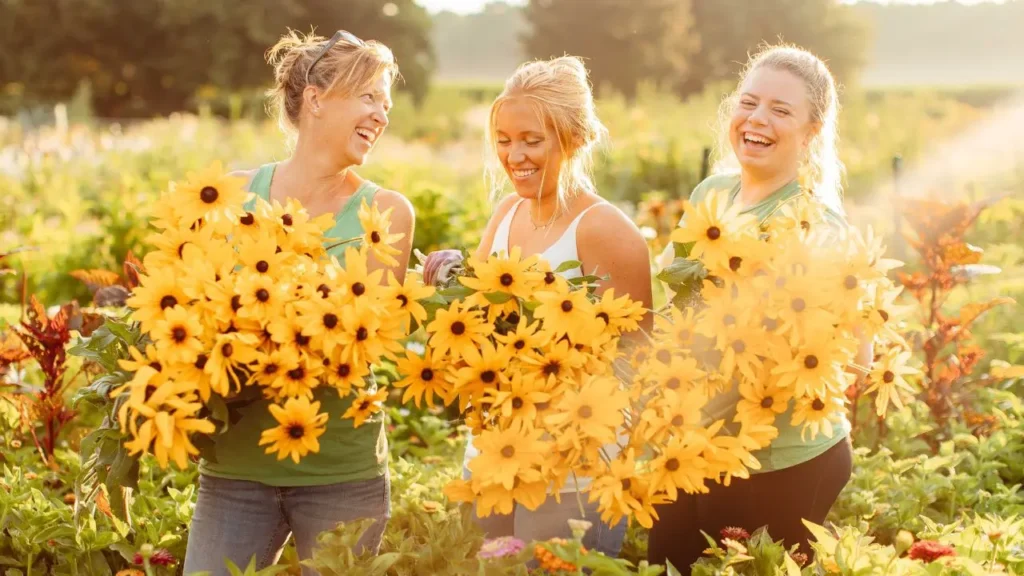
Sunflowers. People know them, identify them, love them, and they are sturdy.
Zinnias. Cut and come again, reliable, always moving.
Lisianthus. In a normal year. This year was not a normal year. We had the best germination rate we have ever had with them, and they still fried in the greenhouse. Everybody else on Instagram is harvesting oodles of gorgeous lisianthus, and ours were tiny and crispy. I think our timing was just off, and they went through real transplant shock.
Dahlias. An enormous amount of work goes into them, but we have hundreds of feet. Big ones, little ones, fluffy ones, ruffly ones. No dinner plates, though. They are so heavy that they are not efficient for the arranging we do, and at that size you also have to get the support structure exactly right. If you are growing them as a garden showpiece, they are magnificent. For our production, they do not make sense.
The flower I stubbornly grew for three years
I once saw this beautiful cherry caramel phlox and thought, wow, that is stunning. So I grew it. And I stuck to my guns and grew it for three years.
It never got taller than about this high. Three full years of production, and I could not put it in a bundle because the stems were too short. We used it in short work and scattered vases, tucking it in wherever we could. There were so many moments when it was the perfect color and we simply never had the stem length.
After three years, we took it out of the rotation.
That is 80/20 in action, and it took me way too long to make the call.
Grow for Your Business, Not for the Suggestion Box
Customers will suggest things constantly. You should grow this. Why don't you have that. Usually it is because that is what they are familiar with, and that is genuinely nice to hear.
But the question is always: does it make sense for you?
Does it make sense for the florist you are trying to wholesale to? For the space you actually have? For the way you arrange? You have to know your industry and your own operation before you say yes.
The 20% of Customers Driving 80% of the Revenue
The same math applies to who you serve.
Wedding clients are a huge driver for us, because we are a farmer florist. We keep detailed spreadsheets on color schemes, palettes, quantities, look, and timing, so our rotations are actually built to meet those needs.
Trends move, and you have to move with them. Two years ago nobody wanted yellow. Now soft yellow has become an integral part of a lot of wedding palettes. Purple is making a comeback. Here on the Eastern Shore we are very coastal heavy, so there is always a significant amount of blue and white, but now we are seeing little touches of other colors woven in. I am genuinely excited about that after years of mostly green and white.
Subscription customers heavily influence what we grow. Sometimes it is a vase subscription, sometimes it is our farmer's bucket. With the monthly buckets I make sure there is something new and different every single month. Weekly customers get a completely different experience, because they watch the whole season shift in front of them. The really deep flower lovers adore that.
Wholesale exists for us, but it is intentionally small. Certain flowers naturally lend themselves to it, and it is simply not our main focus.
Repeat retail buyers matter because we are a florist. Birthdays, anniversaries, funerals, celebrations, get well. We do wrapped bouquets and a lot of vase work, so I have to stay aware of all of those needs when I plan.
Where the Time Actually Goes
Marketing
Not every post performs equally, so what I show has to make sense. Reels, educational posts, storytelling, all of it should reflect real parts of the business.
Social media research is legitimate work. It is fascinating to see the difference between a Facebook customer, an Instagram customer, a TikTok customer, someone who finds us through Google, and someone watching on YouTube. Those are genuinely different people arriving different ways.
But it is so easy to get stuck. You tell yourself you are doing research and suddenly you are deep in a rabbit hole.
Paralysis from overanalysis
Yes, you want a good logo. Yes, you want your materials to line up and look right. Do not get stuck there.
You can have beautiful Canva graphics, elaborate spreadsheets, organizing tools, and supplies. You can spend an unbelievable amount of time shopping for the perfect seed. All of it feels like progress.
What actually grows flowers? What actually grows revenue?
Classes and products
I cannot count how many times someone has said, oh my gosh, I wish you would do a class on X. So we do it. We build the class, set up the infrastructure, create the listing, pull all the pieces together. And two people show up.
I am not looking for fifty. I love the small, intimate relationships that come from teaching a class and having people out to the farm. But there is a real difference between what people say they want and what people buy.
We run dried flower crown classes, fresh flower crown classes, and wreath classes, roughly once a month until Christmas, and then more frequently as people come out to make wreaths, forage, and build gifts.
The question stands no matter what you sell, flowers or jewelry or a homemade product or a course: what offer actually sells?
Do not assume. Look at your numbers and ask what they are telling you!
View Wildly Native's On the Farm Experiences Here
The Tulip Debate
We have argued about tulips on this farm for years.
Tulips take an enormous amount of time. You select the bulb, plant it, protect it, manage it all season, and rotate your growing areas so you do not build up disease. Then you have to harvest at exactly the right moment, and heaven forbid that lands on a weekend when you have a wedding or your staff is off.
Then, because they are an annual crop for us, you pull them out of the ground, wash them, cut the bulb off, and throw all of it away. Muddy, messy work.
They are beautiful. They are magnificent. There are also a ton of flowers that are amazing in spring. Do tulips have to be one of them?
That is a real, ongoing conversation here, and it is exactly the kind of question 80/20 forces you to ask.
Questions That Reveal Your Real Priorities
Here is how you find your own 20%. Sit with these.
- If you could only work two hours today, what would you do?
- If you could only grow five flowers, what would they be, and why?
- If you could keep only one marketing channel, which one? This one is genuinely hard, because reach differs so much by product.
- If you could sell only one product, which one?
Your answers are your priorities. Not the list you think you should have. The one that comes out when everything else is stripped away.
This Applies Well Beyond the Farm
Where does most of your energy go? Your kids? Your friendships? Your partner? Someone you care for? It depends entirely on where you are in life, and it matters.
And what about you? What do you do for your health? For your downtime? For you?
One of my personal favorites: what do you do to keep learning? To keep going and stay on the edge of things? (It probably should not be the internet, but there is a lot of information in a lot of places.)
What are the top things you do for your home? For your happiness?
Because sometimes 20% of our habits create most of our stress. And sometimes 20% create most of our joy.
This is the part I keep coming back to. The 80/20 question is not really about efficiency. It is about not running yourself into the ground. When I talked with Sarah Campbell of Intrigue Designs, she had just come out of a full burnout week, sitting in her garden and reposting old content. Someone with a full team behind her. It happens to all of us, and the work you keep that never earns its space is part of why.
Your Challenge This Week
Write down everything you do. Everything.
This is hard. It is really, really hard, and I am not great at it. But when I am disciplined enough to write it all down and then go back and circle the few things that genuinely move my goals forward, the picture gets so much clearer.
Then I can ask the real question: what do I need to stop doing?
Because success usually is not about adding more. I have a very hard time grasping that. It is about protecting the few things that matter most.
Take the time. Reflect. Find your joy.
Frequently Asked Questions
What is the 80/20 rule in flower farming?
The 80/20 rule, also called the Pareto principle, is the observation that roughly 80% of your results come from about 20% of your effort. On a flower farm, that usually means a small number of crops generate most of your profit, a small number of customers generate most of your revenue, and a small number of tasks account for most of your progress. It is not an exact formula. It is a filter for deciding where your time and space should go.
How do I figure out which flowers are most profitable on my farm?
Start with your actual sales records rather than what is popular or what customers suggest. Look at which crops sell out consistently, which ones serve your highest-value channels, and how much labor each one requires from planting through post-harvest. A flower can sell well and still be a poor use of space if it demands disproportionate time. Stem length, vase life, and whether it fits the work you actually do all factor in.
Should I grow the flowers my customers ask for?
Not automatically. Customer requests usually reflect what people are already familiar with, which is useful information, but it does not mean the crop fits your space, your arranging style, or the buyers you sell to. Ask whether it makes sense for your business before adding it to the rotation.
Are tulips worth growing on a small flower farm?
It depends on whether you can absorb the labor. Tulips require bulb selection, planting, season-long protection, rotation to avoid disease buildup, precisely timed harvest, and, when grown as an annual crop, pulling and disposing of the bulbs afterward. They are beautiful and they sell, but there are many other spring crops, and the harvest window often lands at inconvenient times. It is worth running the real numbers rather than assuming.
What does busywork look like on a flower farm?
Common examples include deadheading crops that are going out of season anyway, weeding sections that are not affecting current production, reorganizing tools or spaces instead of planting, and spending hours on a single social media post. These tasks feel productive because they are visible and finishable, which is exactly why they are easy to hide in.
How do I know if I am spending too much time on marketing?
Ask whether the activity is producing anything measurable. Researching trends and studying what performs is real work, but scrolling can quietly turn into a rabbit hole. The same goes for perfecting logos, graphics, and spreadsheets. If you cannot connect the hours to flowers grown or revenue earned, it is worth questioning.
What is a good exercise for finding my own 20%?
Write down everything you do for a week, then circle only the items that genuinely moved your goals forward. The uncircled list is your answer. From there, the useful question is not what to add, but what to stop doing.
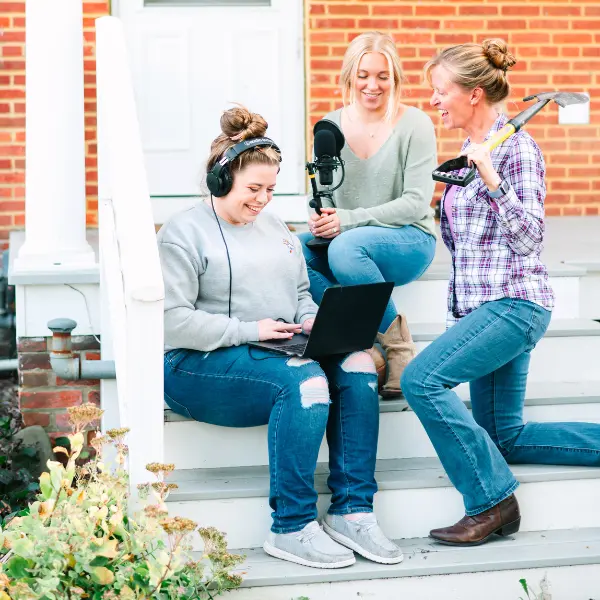
Listen to the full episode of The Flower Files, Episode 128, for the complete conversation.
Now I want to hear from you! If you could only grow five flowers next season, what would they be? Send us a message on Instagram at @the.flowerfilespodcast