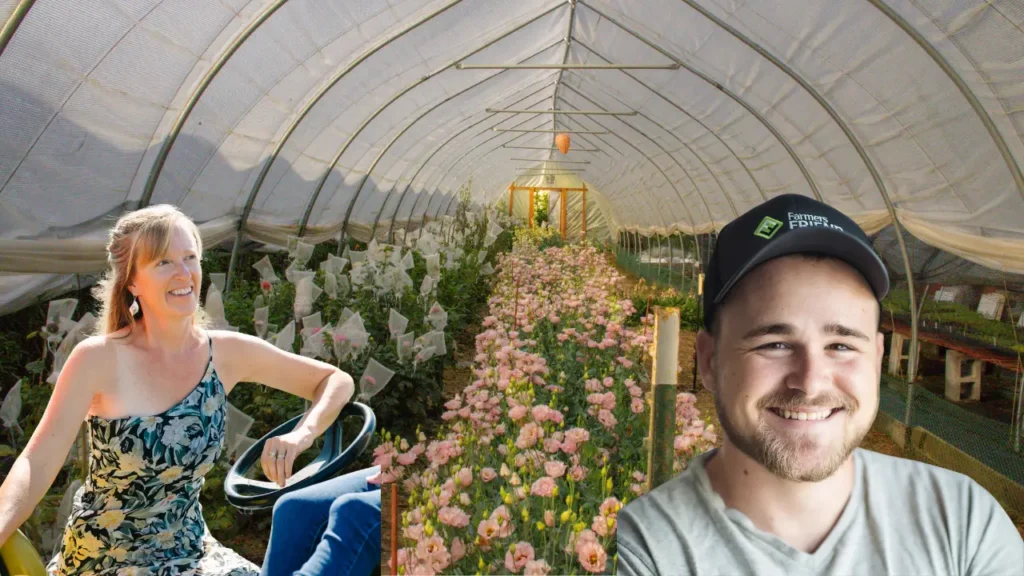

When you're a newer grower and you start thinking about how to extend your season and make more money, one of the first things you're going to think about is a hoop house. I did too! But before you buy one (or another one), let's figure out if it actually makes sense for you.
So I'm taking you on a walk around our farm. We'll start in our greenhouse, then go through all four of our hoop houses, from the shiny kit to the bootstrapped one that's given me the most trouble, and finish with the low covers we use out in the field. I'm showing you the pretty parts and the reality after you've had these structures for a few years.
If you're still deciding which structure fits your farm, start with my greenhouse vs. hoop house guide. This post is about what happens after you have one.
Greenhouse vs. hoop house: what's the real difference?
A greenhouse is fully temperature controlled. It gives you true heat in the winter and active cooling when it gets hot. A hoop house is heated by the sun and cooled by opening it up. It protects your plants, but it's not a heated space.
That difference shapes everything about how you use them. On our farm, things start in the greenhouse, step down to our first hoop house to adjust, and then go out to the field.
What does it take to run a greenhouse?
More infrastructure than you might think. Ours started as a kit from GrowSpan, and the kit is only the beginning. Our heater runs on propane, and you also need electricity for the fans, vents, and blower. So before anything else, make sure that's in place.
How we keep it from overheating. Even when it's 55 degrees outside, a closed greenhouse can get close to 100 degrees inside. (For those of us with that low-light winter grumpiness, it's lovely in there. For the plants, not so much.) Ours cools in two steps, each on its own thermostat:
- When it hits the first set temperature (say 65 degrees in winter), the louvers open and let heat out the top.
- If it keeps climbing, the exhaust fan kicks on, the vents open, and cool air gets pulled across the whole space.
Because that cold air pulls in hardest near the vents, the trays closest to them need to be my most cold-hardy crops, and that soil dries out faster, so I check it more often. (Also, that fan is big. Don't have your hair down near it!)
Other things we've learned:
- Plastic trays over benches. Ours are simple washable trays we ordered online. They don't rot like wood or have the issues metal can, and they're easy to move inside and out.
- The blower keeps the heat in. It inflates the space between the two layers of plastic on the roof, which insulates the greenhouse. Ours rattled, so we hung a can filled with gravel from the greenhouse floor on it. It's worked for years.
- Seal the sides for winter. I used to tuck bags of mulch along the sides so wind couldn't sneak in. This year we're adding channel and an inner layer of plastic so the sides don't billow.
- Check your door latch. Ours wasn't catching right and we didn't notice all summer because the door is always open. Then a winter windstorm blew it wide open. Tiny detail, big difference.
- The birds and cats will find it. Birds try to nest under the heater every fall because it's warm, and I'm up in the middle of the night on the first cold one making sure the nest is out. Our cats wanted in so badly that we met them halfway with a crate of pine shavings. They stretch and say thank you every morning.
Is heating a greenhouse worth it? For long crops like eucalyptus that live in the greenhouse a long time, you have to run the numbers. You're paying for propane overnight and on cloudy days, plus electricity, plus your time. Greenhouse therapy is real, but make sure it makes sense financially.
Hoop house #1: the kit (and my first big mistake)
This was the purchase where I stepped back and thought, okay, I think I'm a real farmer. It's a kit from Farmers Friend, and I chose it because every piece arrived together in one shipment. Nothing to source, nothing to figure out.
I built it myself, too. The only thing that stumped me was the self-tapping screws. I called my dad, and his advice was to push a little harder and give it a little oomph. It worked.
Then I built it in the wrong place. I put it on the other side of the house because I was so worried about wind. Every time I needed water, the hose ran across the driveway, everyone drove over it, and because it was so long, it froze. All my work was on this side of the farm. So we moved it. Wind is something to think about, but don't let it outweigh being close to water and the rest of your work.
When we moved it, we added roll-up sides, and they changed everything. Instead of walking to every post and lifting the plastic, you turn a handle and the whole side goes up or down. When a thunderstorm is coming and you need to drop the sides fast, my whole family can tell you it's so much easier. If you're on the fence about roll-up sides, don't hesitate.
| Roll-up sides | Push-up sides | |
|---|---|---|
| Opening it up | Turn a handle, the whole side rolls up | Walk the length, push the plastic up, prop it with boards |
| Storm coming | Drop the side in seconds | Run around and hope you beat the rain |
| Rain | Sheds water | Water pools into heavy "bladders" that can crash down and break your props |
| Worth it? | Absolutely | Only if you're bootstrapping |
Other lessons from hoop house #1:
- Lay landscape fabric along the outside edges. Mowing is easier and the mower is less likely to throw something into your plastic.
- We started with no end walls. Just plastic pulled down to T-posts, and I'd lift the side and crawl in. It worked, but I had no idea how hot it would get in there. Learning to manage that daily temperature swing was a huge lesson.
- Screw your cross clamps into the center purlin. The purlin is the backbone running down the center, and the hoops are the ribs. Those self-tapping screws at each cross clamp give the whole structure its stability. When you're tired it's easy to miss one, so double check.
- Put duct tape over the cross clamps. The wind moves your plastic constantly, and the clamps rub. A piece of tape on top cuts that wear.
- Algae on the plastic is normal. You can wash it. I don't.
- Add anti-billow plastic. A strip of plastic along the side keeps the wind from puffing the wall in and out.
This hoop house has two layers of plastic because we plan to run electricity to it. There's a small heater in the back that I turn on only on the most frigid nights. It's our step-down space between the greenhouse and the field.
And yes, there's a volunteer cherry tomato in there that we never planted, never fertilized, and only watered by accident. It grew through the gravel and landscape fabric into the ground, we've cut it back by half, and it's still blooming. So does a hoop house help things grow? Absolutely.
Will plants freeze in a hoop house?
Yes, they can. I want to be really clear about this one. A hoop house does not mean things won't freeze. If it's cold enough for long enough, or your sides aren't closed correctly, or you get tied up somewhere and forget, you can still lose plants. That's why we still drop frost cloth over crops inside the hoop house on cold nights. Anemones, ranunculus, and snapdragons all appreciate that extra layer.
How much hotter is a hoop house than outside?
On our farm, with the sides open, it runs about 20 to 25 degrees warmer inside than outside:
- 50 degrees outside is about 70 inside
- 70 outside is about 90 inside
- 80 outside is 100 or more inside
If everything is closed up tight, it spikes even higher. In summer we put shade cloth over the top. It cuts some light, but it keeps things cooler and more bearable for the plants baking in there.
Hoop house #2: the bootstrapped one
This one isn't a kit. It came from a grower who used it for a totally different crop, and I figured hoops are hoops, so I could save a little. It's given me the most problems of any structure on the farm.
- No roll-up sides. We push the plastic up by hand and prop it with wooden paddles we made. If you don't roll the plastic under, rain collects into big bladders that splash down, and we've broken a lot of those boards.
- Mismatched pipe. The hoops are thinner than our center purlin. I've never been able to get a self-tapping screw through them cleanly, and the cross clamps don't grip well with two different widths.
- Sharp edges. We added pipe protectors (pool noodles!) so the frame wouldn't cut the plastic as it moved.
- The rope needs constant attention. Rope laced across the top holds the plastic down. We run it through eye bolts with links I can unscrew, but it loosens over time, so you have to keep tightening it. Farmers Friend has a great explanation of how to lace it correctly.
If you're going to bootstrap, have a really good plan for every part of it.
Hoop house #3: simple end walls work
A lot of people build beautiful end walls. Ours are plastic sandwiched between two boards and screwed together, with the plastic screwed down at the bottom. It's not fancy carpentry, and I'm sure some carpenters are cringing, but it lets in extra light for that first section of the bed, it holds up, and when it's time to change the plastic, it comes apart easily.
This is also where the rotation balancing act happens. I'm still harvesting from some of these crops, but I have to pull them in time to get the spring crops in. Our sweet peas are in, and a few have struggled, which is a good reminder that unless your ground is perfectly flat, you'll have high spots and low spots.
Hoop house #4: our "Taj Mahal"
The first time I stepped into a hoop house this big, I knew I needed one. Then I saw the price. Then a friend bought a property with hoop houses on it and didn't want them, so we took this one down and rebuilt it here. (Tip if you ever do this: we labeled one side with letters and the other with numbers. Then life and storms happened and some of the labels washed off. Use something permanent.)
Bigger hoop houses hold a steadier temperature. The big swings we get in the small ones are much gentler in here. It still freezes, but it's more even.
Animals will come in. I really thought they'd be intimidated by a structure. They're not. We've had deer, foxes, and rabbits, and we usually end up with a nest of baby bunnies in one hoop house every year. We run wire down the sides, but plan for visitors.
One hot day can wipe out a crop. Lisianthus is one of our biggest cash crops. We use it in weddings and arrangements because it lasts so well. This year we planted one whole side of this hoop house with it, and while the plants were still tiny we had one incredibly hot day. They baked. We lost most of them, and it was too late in the season to replant. Fewer things go wrong under cover, but things still go wrong.
How we set up the beds:
- Landscape fabric walkways. We're big believers in not weeding. Defined beds tell us exactly where to fertilize, amend, and work the soil.
- Keep beds off the windy edge. Our outside bed on one side had the most pest pressure, wind, and cold air dropping right onto the crop, and the most losses. We moved the bed in and ran fabric to the plastic, and the problem mostly went away.
- Hose guides at the ends keep the hose from dragging across the beds. (Hose rollers kept popping out on us.)
- Drip irrigation is going in. It's so nice to just turn it on and let it go.
If you want to see what we actually grow in our hoop houses, listen to what we grow in ours.
How to use frost cloth (Agribon) on your crops
Low covers are the simplest season extension, and there's still a learning curve.
Thinner vs. thicker frost cloth. A thin cover lets in more light but tears more easily. A thicker cover is more like fabric, holds up better, and gives you about 5 to 7 degrees of protection, with a little less light coming through.
So know your crop and why you're covering it. Need temperature protection? Go thicker. Mostly blocking wind? A thinner cover may do. Larkspur, for example, loves a little extra protection but also wants a lot more water.
Things nobody tells you about row cover:
- Your weeds love it too. They keep growing underneath, so you still have to weed.
- You may need to water in winter. Two winters ago we had a drought and I never thought about winter being dry. Our spring plants really suffered. Check your soil under the cover.
- Snow and ice mean it all comes off. The weight pushes it down onto the plants. That's a lot of labor every time the forecast changes.
- Pets. Tying the cloth closed didn't work for us, and our cat thinks blowing frost cloth is the best toy ever. That's how our latest section got ripped.
When we pulled the cover back, the difference between covered and uncovered plants was obvious. It works, it just takes work.
Quonset vs. gothic arch: which hoop house shape is better?
Our hoop houses are Quonset style, with rounded hoops. They're great unless you get a lot of snow, because snow can sit on that rounded top. I've gotten very good with a long push broom in the middle of the night tapping snow off (and yes, you get wet). If you live where it snows a lot, look at a gothic arch style, whose peaked roof sheds snow more easily.
What I'd do differently
- Site it close to water and your work, not where you're most afraid of the wind.
- Buy the roll-up sides from the start.
- Lay landscape fabric around the outside and in the walkways.
- Screw in every cross clamp at the purlin, and tape over them.
- Bootstrap only with a plan for every part, especially sides and pipe sizes.
- Watch the thermometer, especially with young transplants.
- Do the math first. Propane, electricity, plastic, and your time all count.
Is a hoop house worth it?
It can be. Everyone's quick to say "let's add a greenhouse, it'll extend our season." It may extend your season, but will it expand your bottom line? Know your crop, know what you'll do with it, and know how you'll sell it before you build.
If you're starting a flower farm or thinking about your next structure, take some time to plan your season first. My free Cut Flower Garden Planning Guide helps you make sure you're on the right path for the right time of year. And because everything in a hoop house starts with the ground it's growing in, Soil Made Simple walks you through what your soil actually needs, no chemistry degree required.
Want to hear more about choosing and buying a hoop house? Listen to my conversation with Jonathan from Farmers Friend.
Frequently Asked Questions
Do plants freeze in a hoop house?
They can. An unheated hoop house protects plants, but if it's cold enough for long enough, or the sides are left open, crops can still freeze. Many growers add frost cloth over crops inside the hoop house on the coldest nights.
How much hotter is a hoop house than outside?
On our farm, about 20 to 25 degrees warmer with the sides open. A 70 degree day means about 90 inside. Closed up tight, it gets even hotter.
Are roll-up sides on a hoop house worth it?
Yes. Roll-up sides let you vent or close the whole side with a crank, which saves time every day and makes it much faster to close up before a storm.
Is a Quonset or gothic arch hoop house better?
Quonset hoop houses have rounded tops and work well in areas with little snow. Gothic arch hoop houses have a peaked roof that sheds snow more easily, which makes them a better fit for snowy regions.
How do you keep animals out of a hoop house?
Running wire along the sides helps, but rabbits, deer, and foxes can still find their way in. Seal the structure at night when you can, and expect the occasional visitor.
Do you need to water plants under frost cloth in winter?
Sometimes. Frost cloth lets rain through, but in a dry winter plants can still suffer from drought. Check the soil under your covers regularly.
How much protection does thick frost cloth give?
A heavier frost cloth gives roughly 5 to 7 degrees of protection, with a little less light coming through than a thinner cover. It also tears less.