One of the questions I hear most from newer flower growers is some version of, "Do I need a greenhouse?" And my answer is usually another question: what are you trying to make the greenhouse do?
Because sometimes you need a greenhouse. Sometimes you need a hoop house. And sometimes you need a few hoops, a roll of Agribon and about 20 minutes. Those are very different investments!
Growing structures can completely change what's possible on a flower farm, or even in a backyard cutting garden. They help us start earlier, harvest later, protect delicate crops, keep rain off our flowers, shade plants through brutal summer weather, and get a little more control over the one thing farmers have almost no control over: the weather.
But here's where growers get into trouble. We start shopping for the structure before we've figured out the problem.
The Short Answer
- Need a controlled space for seed starting and propagation? Look at a greenhouse.
- Want to extend your season over a larger growing area? Consider a hoop house (also called a high tunnel).
- Want walk-in space that's more temporary or movable? Look at a caterpillar tunnel.
- Protecting a bed or two, or just experimenting? Start with low tunnels.
- Worried about frost? Use Agribon or another row cover in the right weight.
- Fighting summer heat? Think shade cloth.
- Fighting insects? Consider insect netting.
And these aren't either/or. A flower farm might use every single one of them.
Start with the problem, not the structure
Before you spend thousands of dollars (or convince your spouse that what the property really needs is just one more structure), ask yourself what you're actually trying to accomplish. Do you want to:
- Start flowers earlier in spring?
- Keep producing later into fall?
- Overwinter hardy annuals?
- Protect young plants from frost?
- Keep rain off delicate blooms?
- Protect plants from wind?
- Provide shade during summer?
- Start seeds and grow transplants?
- Protect a particularly valuable crop?
- Have more control over temperature?
Your answer matters, because these problems don't all have the same solution. If you're protecting a bed of hardy annuals from a couple of cold nights, a greenhouse is a very expensive fix. On the other hand, if you're starting thousands of seedlings every year and need a real propagation space, Agribon stretched over a few hoops isn't going to cut it.
Figure out the job first. Then choose the tool.
Growing structures at a glance
| Option | What it is | Best for | How much control | Permanence and cost |
| Greenhouse | An enclosed structure that may include heat, fans, automated vents, benches, lighting and irrigation | Seed starting, propagation, tender plants | The most. You can actively heat and cool it | Permanent, and the most expensive to build and run |
| Hoop house / high tunnel | A walk-in structure of metal hoops covered in greenhouse plastic, heated by the sun and vented with roll-up sides and doors | Season extension over a larger area, keeping rain off crops | Moderate. The sun does the work and you manage the venting | Semi-permanent, mid-range cost |
| Caterpillar tunnel | A lighter, simpler walk-in tunnel | Seasonal protection you can move or rotate | Moderate | Movable, less of a commitment than a high tunnel |
| Low tunnel | Hoops over a single bed or row, covered with row cover, plastic, netting or shade cloth | Protecting individual beds, learning protected growing | Some | Temporary and inexpensive |
| Row cover (Abgribon) | Lightweight fabric that lets light, air and water through | Frost protection, extra layer inside a tunnel | A little, especially on cold nights | Reusable, the lowest cost |
| Shade cloth | A cover that reduces intense sunlight | Summer heat | Cools rather than warms | Reusable, low cost |
| Insect netting | Fine mesh that physically keeps pests out | Pest pressure | None for temperature | Reusable, low cost |
What is a greenhouse, and when do you actually need one?
A greenhouse gives you the most control over the growing environment. Unlike a typical unheated hoop house, it may include heating, fans, automated ventilation, benches, supplemental lighting, irrigation and other environmental controls.
That control is incredibly valuable for propagation and seed starting. If you're starting large quantities of seed, rooting cuttings, or growing tender plants while it's still cold outside, a greenhouse is a wonderful tool. (It's also where we're careful about what we grow in, because seedlings need a clean start.)
But all that control comes with a cost. There's the structure itself, and then potentially electricity, heat, fans, water, maintenance and the time it takes to manage it all.
That's why I don't think every flower grower automatically needs a greenhouse. The question isn't, "Would a greenhouse be nice?" Of course it would! The better question is, "Will I use a greenhouse enough to justify the investment?"
For a lot of small flower farms, a smaller greenhouse dedicated mostly to propagation makes more sense than trying to grow an entire flower crop inside one.
What is a hoop house, and is it the same as a high tunnel?
Yes. You'll hear high tunnel and hoop house used pretty interchangeably, and this is where things get really useful for flower farmers.
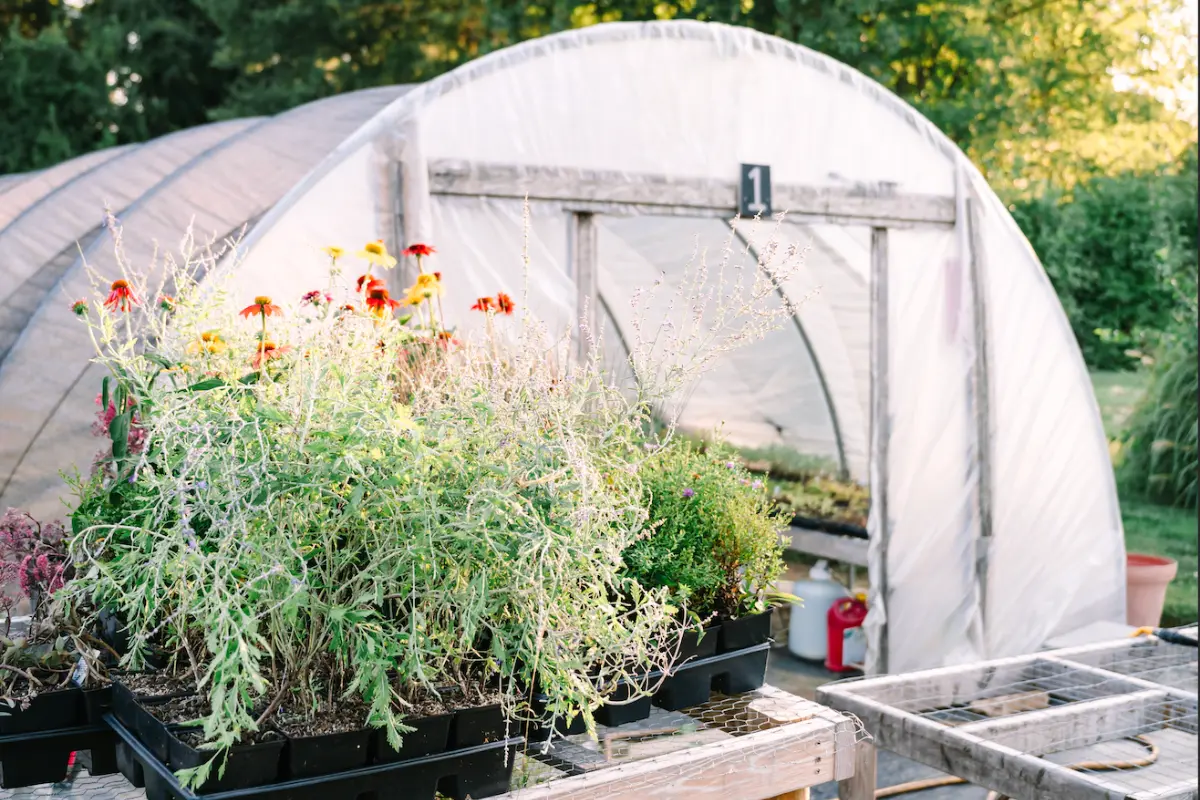
These are walk-in structures, generally metal hoops covered in greenhouse plastic. (If you want to see what we actually grow in ours, Lizzy and I walked through it in Episode 36: Hoop House Growing.) Unlike a climate-controlled greenhouse, they're heated and cooled passively, which means the sun does a lot of the work and you manage the heat with roll-up sides, doors and other ventilation. (Invest in the roll-up sides. Trust me!)
And ventilation really does matter. A hoop house can be wonderfully warm on a cold, sunny morning and surprisingly hot not very long afterward. That's one of the biggest misconceptions about hoop house growing: it isn't something you put up and forget about. You've created a microclimate, and now you have to manage it. That means watching temperatures, opening and closing the sides, keeping an eye on moisture and humidity, and paying attention to what's happening inside instead of assuming everything's fine because it's under plastic.
A hoop house isn't a heated greenhouse
This distinction is so important. An unheated hoop house doesn't magically turn Maryland into Florida in January. It modifies the environment, but the temperature inside can still get very cold at night.
Where a hoop house becomes powerful is the protection it adds up over time. It blocks the wind, keeps rain off the crop, captures warmth from the sun, warms the soil, and gives you the chance to grow outside the normal field window. For a flower farmer, that can mean flowers earlier in spring or later into fall, right when they can be especially valuable.
And sometimes we add another layer of protection inside the hoop house. That's where Agribon comes in.
What is Agribon, and what weight do you need?
Agribon is a brand of spun-bonded row cover, often called frost cloth or floating row cover. If you're new to season extension, it's one of the simplest tools to understand and experiment with. It lets light, air and water through while creating a protected space around your plants.
It also comes in different weights, and heavier isn't automatically better. A heavier cover gives more cold protection, but it also blocks more light from reaching your plants. So once again, you choose the material based on the job.
| Common weight | Light let through (approx.) | Typical use |
| AG-19 (lightweight) | About 85% | Light frost protection, insect barrier, can stay on for long stretches |
| AG-30 (medium) | About 70% | Frost protection in spring and fall |
| AG-50 (heavy) | About 50% | Colder nights, overwintering hardy crops |
You can lay floating row cover directly over some crops, but on the flower farm I especially love supporting it on hoops. Now you've built a little protected environment around your plants.
And here's where season extension gets really interesting: you can put that protected environment inside another protected environment. Plants under row cover inside a hoop house have an extra layer between them and the outside conditions. You don't necessarily need to heat a whole structure to give a cold-tolerant crop a little extra help. Sometimes you're just trying to get it through the coldest part of the night.
What is a low tunnel?
A low tunnel is basically a miniature hoop house. Instead of walking inside it, you build a small structure right over a bed or row. The hoops can be wire, PVC, metal conduit or other materials, covered with row cover, plastic, insect netting or shade cloth depending on the season and what you're trying to accomplish.
If you're a beginning grower, this is one of the places I would seriously consider starting. You can learn an enormous amount about protected growing without committing to a permanent structure. Put hoops over one bed, cover it, and compare those plants to an uncovered row. Watch how quickly the soil warms and how the plants respond. Learn when you need to vent, and what happens under that cover on a sunny 55-degree day.
Because one of the most important lessons in protected growing is that the temperature outside doesn't tell you what's happening under the cover. Sunshine changes everything.
And yes, you can cook your plants
We spend so much time worrying about cold that we forget about heat. A covered low tunnel on a sunny day can get much warmer than the air around it, and the same thing happens inside a hoop house.
That's why a thermometer is one of the least exciting and most useful tools you can put in any of these structures. A battery-operated one that records the high and low temperatures is hugely helpful, and if you can swing it, a plug-in model with live readings is even better. Whatever you choose, make sure you can actually monitor your spaces.
Don't guess. Measure. And then vent when you need to.
Protected growing doesn't eliminate weather management. It gives you another way to manage it.\
What is a caterpillar tunnel?
Think of a caterpillar tunnel as the more temporary, portable cousin of the high tunnel. It's usually tall enough to walk inside and covers far more ground than a low tunnel, but it's designed to be simpler and easier to move than a permanent high tunnel.
That makes it incredibly useful on a flower farm. Maybe you don't need a permanent structure on that spot forever. Maybe you're rotating crops, or you only want protection for one season, or you're not ready for the cost and commitment of a larger high tunnel. A caterpillar tunnel fills that middle ground.
This is one of the reasons I loved my conversation with Jonathan Dysinger, founder of Farmers Friend, for an upcoming episode of The Flower Files (it's coming later this month!). Farmers Friend designs equipment specifically for small-scale farms, including high tunnels and caterpillar tunnels, so our conversation wasn't just about buying a hoop house. It was about how these structures actually fit into a working farm.
And that's the conversation I think we need to have more often. What makes sense for the farm you actually have? Not the farm you saw on Instagram. Not the 20-acre operation you toured. Yours.
Protection isn't always about cold
When we say "growing structure," we immediately think about keeping plants warm. But sometimes the problem is exactly the opposite: it's too hot.
Shade cloth for summer heat
Shade cloth reduces the intense sunlight reaching your plants and helps moderate conditions underneath. Heat and light matter more than people expect. Our best year ever for Bells of Ireland was in hoop house one, and we think it's because that house gets afternoon shade. Everywhere else, they grow to about a foot, summer arrives, and they simply stop.
The same hoops you used for frost cloth in spring can often hold shade cloth later in the season. That's why I love thinking of the structure and the covering as two separate tools. The hoops are the framework, and what you put over them depends on the job. Spring might mean frost protection. Summer might mean shade. Pest pressure might mean insect netting.
It's not always about building something new. Sometimes it's about using what you already have differently.
Insect netting: a barrier instead of a spray
Insect netting doesn't trap heat the way heavier frost protection can. Instead, it creates a physical barrier between your crop and certain pests. There are different mesh sizes for different insects, so this is another case where you need to know the problem before buying the solution.
The bigger idea is what matters here: not every farm problem needs to be solved with something you spray. Sometimes the answer is simply keeping the problem out. (And it isn't always insects. One year the goldfinches went through our Joe Pye weed trays and took every single seed, so the whole thing ended up under Agribon.) When we're trying to build healthier farms and gardens that support beneficial insects and pollinators, having more tools in the toolbox matters.
Don't forget about wind and rain
We talk a lot about temperature, but flower quality is affected by much more than frost. Wind can beat plants up, and honestly, sometimes it's worse than insect damage. Heavy rain damages blooms. Tall stems snap or tangle together. Some flowers just look better when they're protected from repeated rain.
So a structure that keeps rain off a valuable crop can be worth it even when you aren't gaining much temperature protection. When you're growing flowers to sell, you're not just trying to keep the plant alive. You're trying to produce a beautiful, usable stem, and that's a very different goal.
Sometimes the best answer is layering
This is one of the biggest things I want newer growers to understand. Season extension doesn't usually come from one magical structure. It comes from layers.
You might have cold-hardy flowers planted in the ground, inside a hoop house, under low hoops covered with Agribon. You're combining the plant's natural cold tolerance with several layers of protection, which is very different from trying to force a heat-loving summer flower to grow in January.
Which brings us to something incredibly important.
The structure doesn't change the plant
You still need to know what you're growing. Some flowers love cool conditions and others absolutely do not. Some tolerate frost, some handle freezing temperatures once they're established, and others are done the moment frost arrives. No amount of clever structure planning changes the biology of the plant.
That's why good season extension starts with crop selection. Choose the right flower, plant it at the right time, and then use the structure to give it an advantage. Don't choose the wrong flower and expect the structure to perform a miracle.
Planning what to grow, and when? Our Garden Planning Guide walks you through choosing flowers and timing your plantings, so any structure you add is working with your plants instead of against them.
Questions to ask before you build
There's a temptation, when you're growing a flower business, to think the next piece of infrastructure will solve everything. One greenhouse. One more tunnel. One bigger cooler. And sometimes infrastructure absolutely does change your business.
But infrastructure also creates work. Plastic eventually needs replacing. Sides need opening and closing. Plants under cover need irrigation because the rain can't reach them. Temperatures need watching, the soil inside needs attention, and pests don't magically disappear. Every square foot you add is another square foot you're responsible for.
So before you build, ask yourself:
- What will I grow in it?
- When will I grow it?
- What problem will it solve?
- How will I irrigate it?
- How will I ventilate it?
- Who's going to manage it?
- Where will it sit in relation to everything else? (I once put a hoop house up too far from the rest of our setup, then dug it up and moved it. By myself.)
And maybe most importantly: will this structure help my farm become more productive, or just give me more work?
Start where you are
If you're a backyard grower, you don't need a commercial greenhouse to start experimenting with protected growing. If you're a new flower farmer, you don't need to order the biggest high tunnel you can afford. (If you're still at the very beginning, start with how to start a flower farm.)
Start with the problem in front of you. Maybe that's one bed of ranunculus you'd like to protect, or hardy annuals you're trying to overwinter. Maybe you want earlier spring flowers, or you're losing quality to rain, or the summer sun is cooking a crop. Solve that problem first.
A few hoops and some Agribon may teach you more in your first season than a giant structure you don't know how to manage yet. Then, as your farm grows, your infrastructure can grow with it.
Growing structures give us options, not guarantees
That's really what all of these provide: options. They don't eliminate weather, they don't eliminate crop failure, and they definitely don't eliminate the need to pay attention. But they let us shift the growing environment just enough to create opportunities we'd never have in the open field. Earlier flowers. Later flowers. Better stems. Healthier transplants. And sometimes a little more sleep when the forecast suddenly says 29 degrees.
Maybe. I'm still a farmer, so I'm probably checking the weather anyway.
If you're thinking about adding a hoop house or caterpillar tunnel, or you're just curious what growing under cover really looks like, take a peek inside ours in Episode 36: Hoop House Growing. And keep an eye out later this month for my conversation with Jonathan from Farmers Friend on The Flower Files, where we dig into growing structures and what these tools look like on real farms.
Because before you buy the structure, you need to understand the job you want it to do. Start with the problem. Then build the solution.
Frequently Asked Questions
Do I need a greenhouse to grow flowers?
No. A greenhouse is most valuable for seed starting and propagation, where you need real temperature control. Many small flower farms and backyard growers do very well with low tunnels, row cover and a hoop house, and add a small propagation greenhouse only once they're starting seed in large quantities.
What is the difference between a greenhouse and a hoop house?
A greenhouse is usually actively heated and cooled with heaters, fans and automated vents, which gives you the most control. A hoop house is heated by the sun and cooled with roll-up sides and doors, so it protects plants and extends the season but can still get very cold at night.
Is a hoop house the same as a high tunnel?
Yes. The two terms are used interchangeably for a walk-in structure of metal hoops covered in greenhouse plastic, heated and vented passively.
What is the difference between a caterpillar tunnel and a high tunnel?
A caterpillar tunnel is lighter, simpler and more portable. It's still tall enough to walk into, but it's easier to move or take down, which makes it useful for seasonal protection or crop rotation. A high tunnel is a more permanent structure.
What is Agribon used for?
Agribon is a brand of spun-bonded row cover, also called frost cloth. Growers use it to protect plants from frost, add an extra layer of warmth inside a hoop house, and keep out some pests. Heavier weights give more cold protection but let less light through.
Can a hoop house or low tunnel get too hot?
Yes. On a sunny day a covered structure can get much warmer than the outside air, even in cool weather. Keep a thermometer inside, ideally one that records highs and lows, and vent whenever temperatures climb.
What's the best season extension tool for a beginner?
Low tunnels with row cover. They're inexpensive, temporary, and teach you how protected growing works, including when to vent, before you commit to a permanent structure.
Can you grow summer flowers in a hoop house in winter?
Not in an unheated hoop house. Structures modify the environment, but they don't change what a plant can tolerate. Season extension works best with cold-hardy flowers, layered protection like row cover inside a hoop house, and the right planting time.