
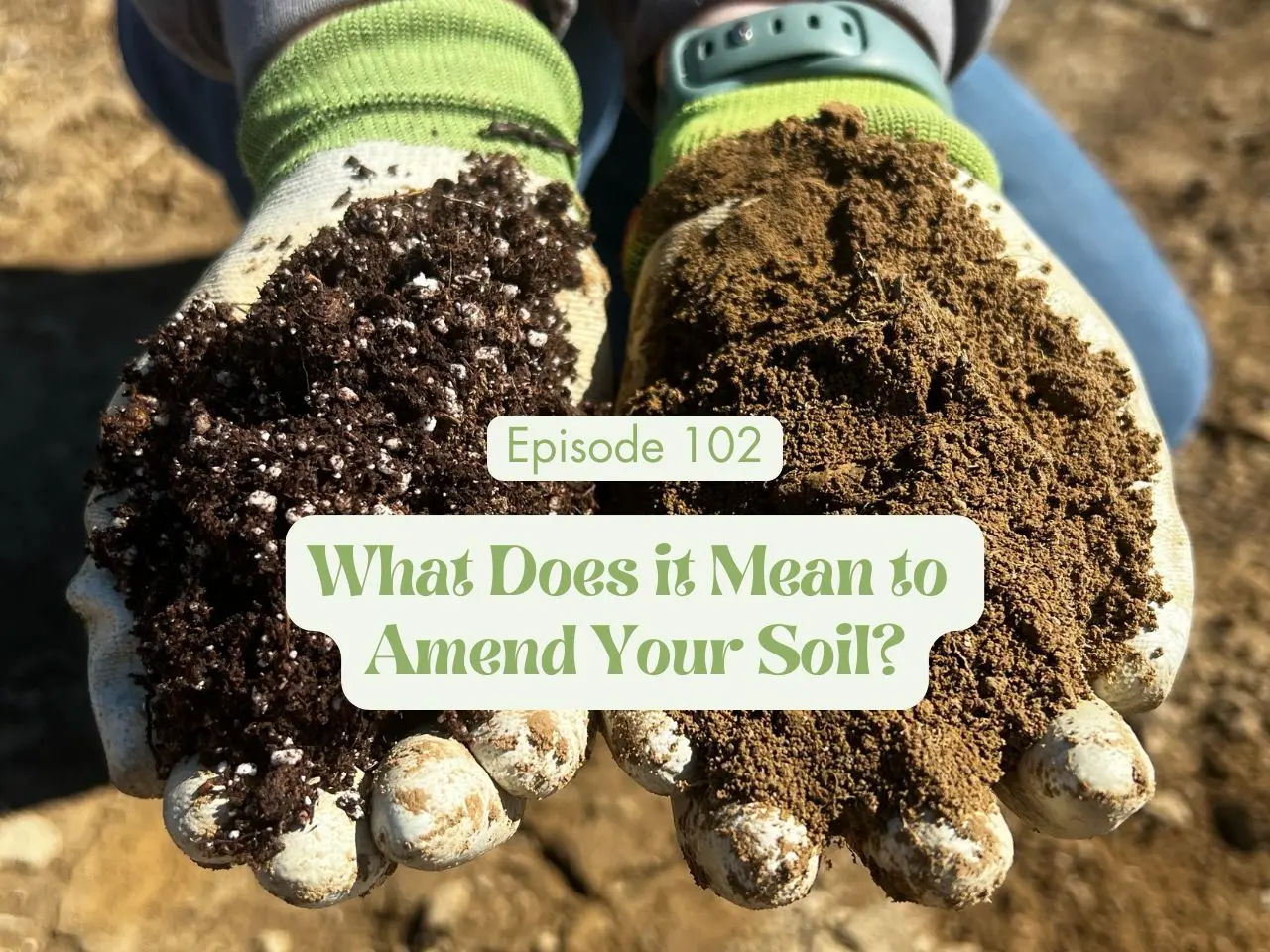
If you’ve ever stood in your garden holding a bag of bone meal, worm castings, lime, or something labeled “plant tone” and thought, I feel like I should be using this… but I don’t actually know why — you are not alone.
In this episode of The Flower Files, we’re breaking down soil amendments in a way that actually makes sense. No chemistry degree required. Just real talk about what your soil needs and how to support it intentionally — especially if you’re growing cut flowers like we are here at Wildly Native Flower Farm.
Let’s dig in.
What Are Soil Amendments (Really)?
Here’s the simplest definition: A soil amendment is anything you add to your soil to improve it.
That improvement could mean:
- Better structure
- Improved drainage
- Increased nutrient availability
- Stronger biological activity (hello worms and microbes!)
Amendments are helpers, not magic fixes. They support soil that’s trying to function — they don’t replace healthy soil.
And here’s the key: they do not work overnight. Soil is a relationship. It takes time, balance, and understanding.
Soil Amendments vs. Fertilizer: What’s the Difference?
This is where a lot of confusion starts.
Fertilizer feeds the plant directly. It’s fast. It’s short-term.
Think of it like a protein shake.
Soil amendments feed the soil system. They:
- Support microbial life
- Improve structure
- Help nutrients move through the soil
- Create long-term resilience
If fertilizer is the quick boost, amendments are:
- Sleep
- Hydration
- Real, nourishing food
Both have a place — but they do different jobs.
Why Most Garden Soil Needs Help
Most soil has been:
- Walked on
- Tilled repeatedly
- Stripped of organic matter
- Compacted over time
Here in Maryland, we deal with tight clay soil and drainage challenges. And here’s something important: Your soil can have nutrients — but plants still may not be able to access them.
That’s called nutrient availability.
Soil amendments improve how nutrients move and become available to your plants. If soil could talk, it wouldn’t ask for “more stuff.” It would say:
“Help me breathe.”
The Main Types of Soil Amendments
Let’s simplify the categories so you can understand what you’re actually looking at when you walk through the garden center.
1. Organic Matter (The Foundation)
Examples:
- Compost
- Aged manure
- Leaf mold
What they do:
- Improve soil structure
- Increase drainage
- Feed soil microbes
- Improve nutrient retention
If you focus on only one amendment category — this is it.
Adding organic matter back into your soil is one of the most powerful things you can do for your garden.
2. Mineral Amendments (The Balancers)
Examples:
- Lime (raises pH)
- Sulfur (lowers pH)
- Gypsum
- Sand (for structure in heavy clay)
These change soil chemistry or structure.
And here’s the important part:
Don’t guess.
Adding minerals blindly can create long-term problems. A simple soil test can help you make informed decisions instead of throwing products at your garden and hoping for the best.
3. Nutrient-Based Amendments (The Targeted Tools)
Examples:
- Bone meal
- Blood meal
- Fish meal
- Kelp meal
These are useful when you know something specific is missing.
They’re not meant to be added just because they sound impressive — or because someone online said so. They’re targeted tools, not general solutions.
4. Biological Amendments (The Underground Workforce)
Examples:
- Worm castings
- Mycorrhizal fungi
- Microbial inoculants
These support the living system beneath your soil surface.
They’re especially helpful:
- When establishing new beds
- After heavy soil disturbance
- When rebuilding depleted soil
But remember: more is not better.
Can You Over-Amend Soil?
Yes — and this is the part no one likes to hear.
- Too much nitrogen = lush leaves, few blooms
- Too much phosphorus = nutrient lockout
- Too much organic matter = drainage problems
Healthy soil is about balance, not abundance.
It’s a system — and every piece affects the others.
Soil Structure vs. Soil Chemistry
Another major point of confusion?
- Soil structure = how your soil physically behaves (compacted, sandy, clay-heavy, well-draining)
- Soil chemistry = nutrient levels and pH
They work together.
You can’t fix chemistry without considering structure. And you can’t improve structure without understanding how it affects nutrient movement.
When those pieces align, that’s when your garden truly grows from the ground up.
Why Compost Deserves Its Own Conversation
Compost isn’t just another amendment.
It’s:
- Structure
- Biology
- Nutrition
- Foundation
In our next episode, we’re sitting down with Ryan from Shore Soils to talk specifically about compost:
- What good compost actually looks like
- How to tell high-quality compost from poor-quality compost
- How compost works with other amendments
Because compost confusion is real — and it deserves clarity.
Soil Amendments are not about fixing broken soil.
They are about supporting soil that’s trying to function.
Your soil isn’t failing you. It’s communicating. You just need to learn how to read its language.And when you do?
Your cut flowers — and your entire garden — will thank you.